
A. 1094-C for Applicable Large Employers (Full-Text)
Form 1094-C is a little more complicated than Form 1094-B, so we’re going to address this one line-by-line (skipping obvious lines like street address).
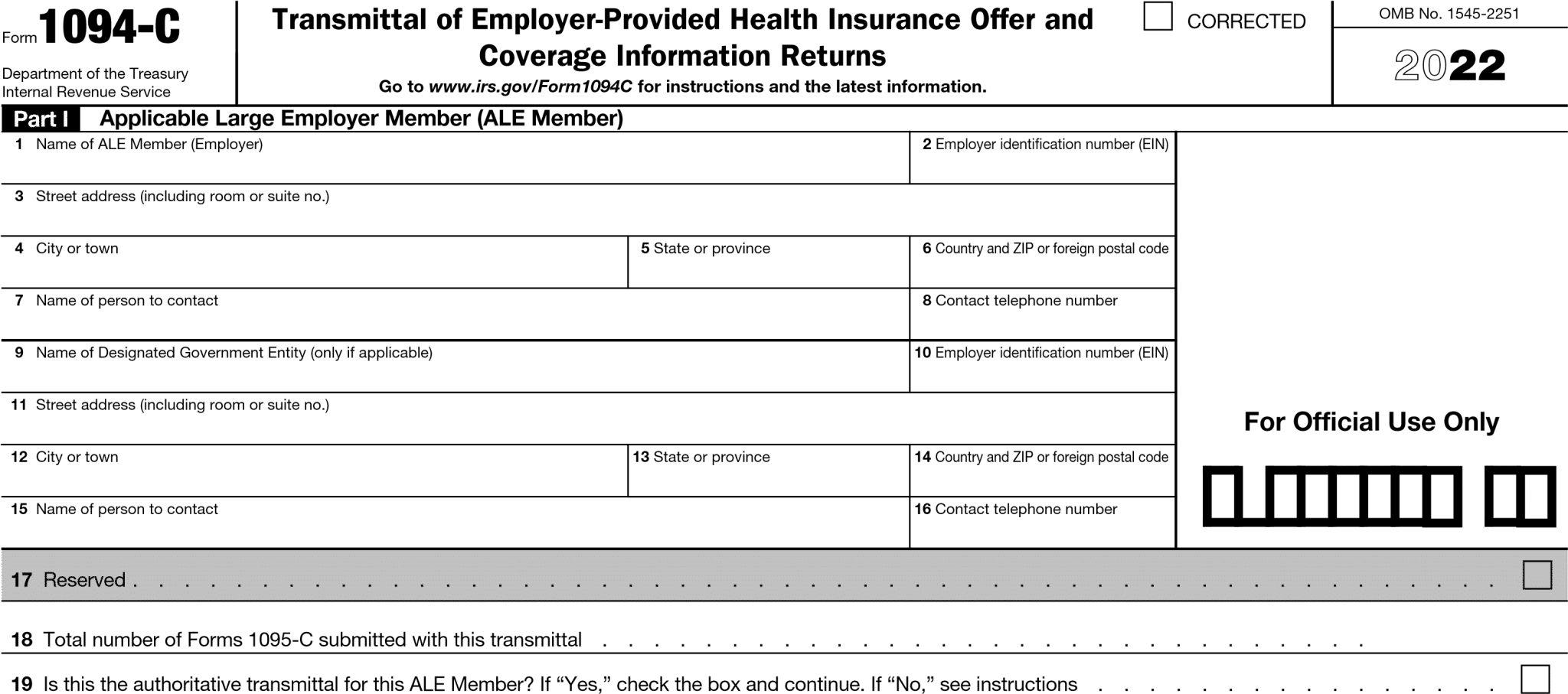
A-1. 1094-C, Part 1, Line 1
A-1(a) Name of ALE Member
- ALE stand for “Applicable Large Employer.”
- An Applicable Large Employer is an employer with 50 or more full-time employees, including full-time equivalent employees (FTEs).
- The term “ALE Member” reflects the possibility that the employer could be part of an “Aggregated ALE Group.” This is a group of employers under common control (part of a “controlled group”) which, together, have at least 50 full-time employees and FTEs.
Thank you for accessing Kinney Health Compliance.
You must own a Affordable Care Act Membership Plan to continue reading.
A-1. 1094-C, Part 1, Line 1
(a) Name of ALE Member
- ALE stand for “Applicable Large Employer.”
- An Applicable Large Employer is an employer with 50 or more full-time employees, including full-time equivalent employees (FTEs).
- The term “ALE Member” reflects the possibility that the employer could be part of an “Aggregated ALE Group.” This is a group of employers under common control (part of a “controlled group”) which, together, have at least 50 full-time employees and FTEs.
Thank you for accessing Kinney Health Compliance.
You must own a Affordable Care Act Membership Plan to continue reading.
- All members of an Aggregated ALE Group are treated as Applicable Large Employers, even if individual ALE Members do not have 50 full-time employees or FTEs.
- All ALE Members are treated as subject to the Employer Shared Responsibility rules.
- All ALE Members are subject to separate reporting under forms 1094-C and 1095-C.
- Failure by one ALE Member to offer coverage or file required returns will result in a penalty to that entity, but not to other ALE Members of the Aggregated ALE Group.
- See Example 3: Phil’s Failure to Identify Controlled Group.
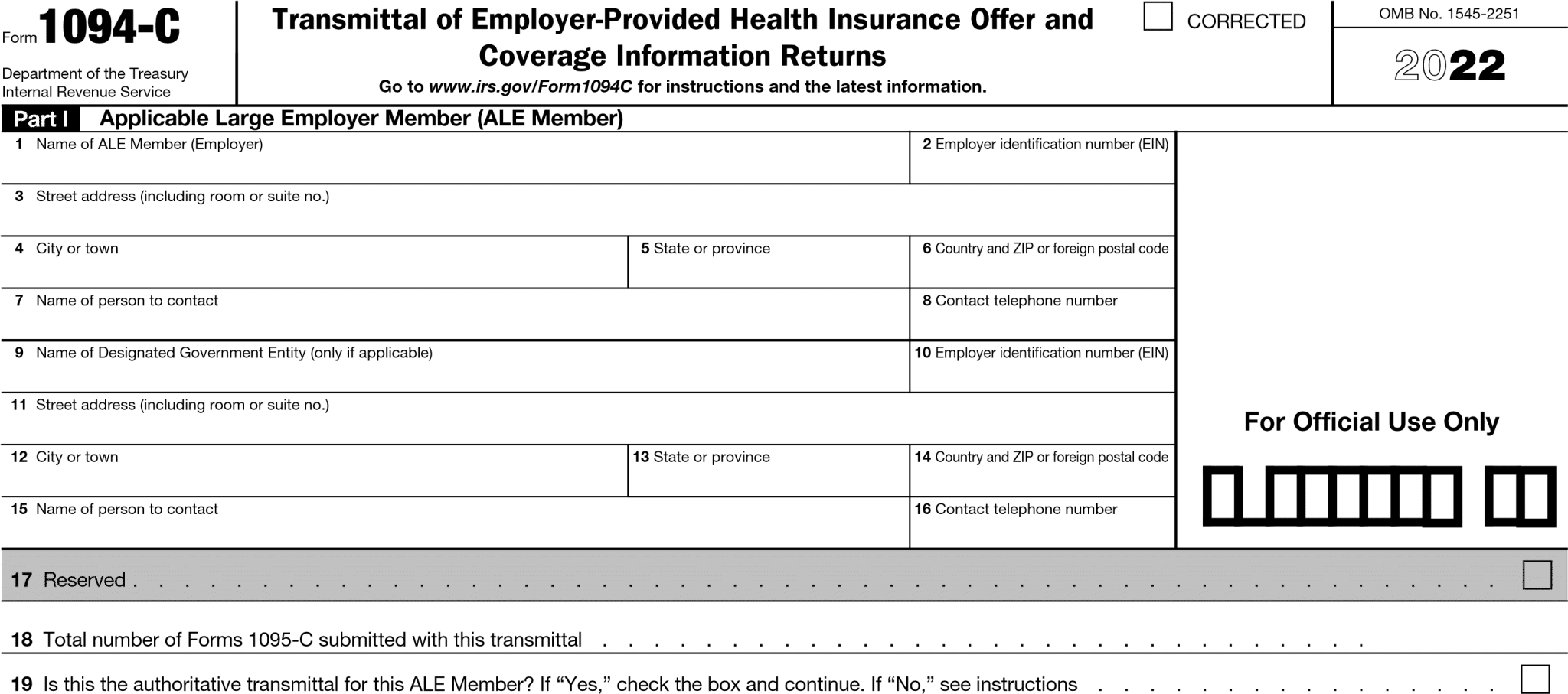
A-1(a). Name of ALE Member
Thank you for accessing Kinney Health Compliance.
You must own a Affordable Care Act Membership Plan to continue reading.
A-1(b). Obligations of ALE Members
Thank you for accessing Kinney Health Compliance.
You must own a Affordable Care Act Membership Plan to continue reading.
A-2. 1094-C, Part 1, Line 9
Thank you for accessing Kinney Health Compliance.
You must own a Affordable Care Act Membership Plan to continue reading.
A-3. 1094-C, Part 1, Lines 18, 19
(a) Line 18. Total number of 1095-Cs submitted
- ALE Members must file one Form 1095-C with the IRS for each full-time employee (whether or not they elect coverage) and for each other employee, former employee, or COBRA beneficiary who has coverage under the plan.
- Exception: You do not have to file Form 1095-C for an employee who is in a Limited Non-Assessment Period for the entire year (i.e., variable hour employees in look-back measurement periods, full-time employees hired near the end of the year who are in waiting periods.).
- Employers must also furnish a copy of the Form 1095-C to each reported employee.
- Applicable Large Employers may use the Form 1094-B and 1095-B series to report coverage for non-employees who were not employed during the year. This includes retirees with VEBA accounts and former employees on COBRA or state continuation coverage. Better yet, they may include a statement on their website saying that these forms, and Forms 1095-C for part-time employees, are available on request. See here for more guidance.
Thank you for accessing Kinney Health Compliance.
You must own a Affordable Care Act Membership Plan to continue reading.
A-3(a). Line 18. Total number of 1095-Cs submitted
Thank you for accessing Kinney Health Compliance.
You must own a Affordable Care Act Membership Plan to continue reading.
A-3(b). Line 19. Is this the Authoritative Transmittal for this ALE Member?
Thank you for accessing Kinney Health Compliance.
You must own a Affordable Care Act Membership Plan to continue reading.
A-4. 1094-C, Part II, lines 20, 21, and 22
(a) Line 20. Total number of 1095-Cs filed by or on behalf of ALE Member (Line 20)
- This should be the same as line 18 for most
- It could be more if a third party (i.e., a DGE) files a separate 1095-C for a portion of the employer’s workforce (such as if the state filed 1095-Cs for teachers)
(b) Line 21. Is the ALE Member a member of an Aggregated ALE Group? (Line 21)
- Back to controlled group issues.
- Check “yes” if you were a member of a controlled group during any month of the prior calendar year.
- Most school districts are not members of a controlled group. They should check “no” in most cases and not complete Part IV in most cases. Cities and counties need to look more closely at this issue before checking no. In Example 3, Phil failed to recognize that the city library was part of a controlled group, and the library, with 10 employees, was assessed a penalty of $43,200. If you recall, the library then held a board meeting and decided to charge Phil $43,200 in fines for his overdue books. Best to be thorough here.
- Cities and counties must use “reasonable, good faith interpretations” of the controlled group rules to determine whether they are part of an Aggregate ALE Group with other government employers. See our discussion of controlled groups This is an area where you might want to engage tax and legal advisors.
(c) Line 22. Certifications of eligibility (select all that apply) (Line 23)
Thank you for accessing Kinney Health Compliance.
You must own a Affordable Care Act Membership Plan to continue reading.
A-4(a). Line 20. Total number of 1095-Cs filed by or on behalf of ALE Member (Line 20)
Thank you for accessing Kinney Health Compliance.
You must own a Affordable Care Act Membership Plan to continue reading.
A-4(b). Line 21. Is the ALE Member a member of an Aggregated ALE Group? (Line 21)
Thank you for accessing Kinney Health Compliance.
You must own a Affordable Care Act Membership Plan to continue reading.
A-4(c). Line 22. Certifications of eligibility (select all that apply) (Line 23)
Box A: Qualifying Offer Method. The instructions to Form 1094-C state to check Box A if the ALE Member is eligible to use, and is using, the Qualifying Offer Method to report the information on Form 1095-C for one or more full-time employees.
A “Qualifying Offer” is defined in the instructions to Form 1095-C as follows:
Minimum essential coverage providing minimum value offered to full-time employees with employee contribution for self-only coverage equal to or less than 9.5% mainland single federal poverty line and at least minimum essential coverage offered to spouse and dependents.
Thank you for accessing Kinney Health Compliance.
You must own a Affordable Care Act Membership Plan to continue reading.
A-5. 1094-C, Part III
Column (a) (Minimum Essential Coverage Offer Indicator). Employers should always check “Yes” in line 23 if they offer minimum essential coverage to at least 95% of their full-time employees and dependents in each month the calendar year. They have to offer MEC to at least 95% of their full-time employees to avoid the possibility of the “awful” penalty under Section 4980H(a). For any month in which an employer checks the “no” box, the employer is not eligible to use an Affordability Safe Harbor code on line 16 of Form 1095-C. This puts you at risk for Section 4980H(b) penalties.
Employers shouldn’t generally check “no” in this line and should leave the other boxes blank (though they must respond honestly if it’s not the case). Think of Form 1094-C Part III as a Section 4980H penalty minefield. If you don’t check yes in line 23 and even a single full-time employee is certified as having received a premium tax credit or cost-sharing reduction through MNsure, the IRS will have you dead to rights with the “awful” penalty under 4980H(a). If you don’t check yes on line 23 and a full-time employee obtains premium tax credits or cost-sharing reductions through MNsure, you cannot rely on an affordability safe harbor.
Thank you for accessing Kinney Health Compliance.
You must own a Affordable Care Act Membership Plan to continue reading.
A-6. 1094-C, Part IV
Thank you for accessing Kinney Health Compliance.
You must own a Affordable Care Act Membership Plan to continue reading.